

The UN Secretary-General, António Guterres, requested an independent inquiry which said he was "alarmed" by reports that agents had opened fire in a hospital.
The United States said it was a "brutal attack" while the United Kingdom called it "scandalous".
Sudan has been ruled by a military council when President Omar al-Bashir was wiped out in a coup in April.
Pro-democracy leaders, demanding that a civilian government take charge of the country's leadership, said they stopped contacting the Transitional Military Council (TMC) and called a general strike.

What happened at the protests?
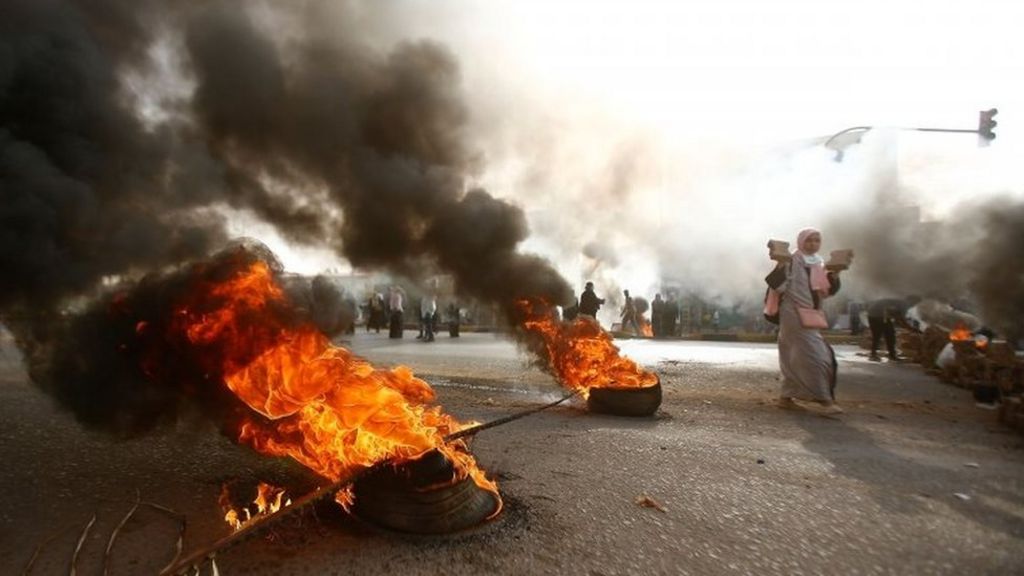
The security services moved to the protest's capital early Monday, the activists said, and a large shootout was seen on video footage.
But TMC spokesman Shams al-Din Kabbashi, Secretary-General, said the forces had moved to a location near the main protocol area, which "had long been the focus of corruption and negative practices".
"The Sudanese forces did not spread sit-in outside the army headquarters with power, but instead went to a nearby area that has become a threat to citizens' security," he told Sky News Arabia television channel. based in the United Arab Emirates.
The activists also said the security forces had surrounded a hospital in Khartoum and opened fire in another.
The central committee of Sudanese doctors, close to the protesters, said that 30 people, including an eight-year-old boy, had been killed and that the number of victims was likely to increase as not all victims had been registered.
Hundreds of people were injured, he added.
Some residents owe the infamous paramilitary unit known as the Rapid Support Forces created to hold Mr. Bashir in power and rooted in the Darfur conflict in western Sudan, which began in 2003.
As known as "janjaweed", this militia performed frequent killings.
The Confederation of Sudanese Professionals (SPA), which spearheads the country, called for a "sweeping civil disobedience sweep to overthrow the dangerous and murderous military council."
What has the reaction been?
The UN Secretary-General called on the Sudanese authorities to facilitate an independent investigation and to hold those responsible.
"He condemns the use of force to spread the demonstrators at the location site and is alarmed by reports that security forces have opened fire in medical facilities," said a statement by Mr Guterres.
In another reaction:
United Kingdom Foreign Minister Jeremy Hunt said this was "a scandalous move that will only lead to greater polarization and violence" and that the military council "has all responsibility"
Tibor Nagy, Assistant Secretary of State for Africa in the United States, said: "This was a brutal and coordinated attack led by the military in the rapid support forces reflecting some of the Bashir regime's worst crimes."
The African Union demanded an immediate and transparent investigation.
The state news agency in Sudan said the prosecutor had set up a committee to investigate the violence.
The power of the people has great success
Analysis by Tomi Oladipo, BBC Security Correspondent in Africa
It is back to square one for the political process in Sudan. The hardened conditions that paralyzed the conversations between protest groups and FTB have been further consolidated on both sides.
Expect more determined protests and an even more ruthless offensive by uniformed men. The last ones are those who now govern. What matters is which security strength fraction has the advantage in TMC.
The fans of the hardliners, especially the fast supporting forces, led by the regime's deputy chief, Mohamed "Hemeti" Hamdan Dagalo, seem to be indicative and can show more cruelty than has been seen so far.
There has been a total blockage in Khartoum, suggesting that something has changed within the regime. "The power of the people" takes a big hit, but the protesters may be willing to take greater risks to force the army's hand, if possible.
What is the background?
Protesters have been occupying the square in front of the military quarters since April 6, five days before Mr Bashir was overthrown.
Last month, the organizers and the ruling generals announced that they had agreed on the structure of a new administration and a three-year transitional period to the civilian government.
But they still have to decide on the composition of what is called the Supreme Council, which will be the highest decision-making body during the transition period.
They cannot agree on whether civilians or the military should have the most posts.

